
CRYPTO EXCHANGE COMPARISON / UPDATED OCTOBER 2026
Best crypto
exchanges 2026.
Compare the platform. Understand the costs. Build your crypto trading workflow.
Binance, Coinbase, Kraken, OKX and Bybit form our research shortlist for 2026. Choose by your available account, spot or derivatives needs, trading costs and withdrawal route. The right platform fits your process and the markets you actually trade.

The best crypto exchange in 2026 depends on what you need to do. Buying an asset and withdrawing it to a wallet is a different task from actively trading BTC perpetuals. Comparing both through one headline fee or one mobile-app rating hides the details that matter.
This guide compares five exchanges through practical questions: which markets can you access, how is the order priced, what happens when you withdraw, and can you repeat your trading workflow clearly? We reviewed official product and fee documentation. This is a research shortlist, not an independently audited security assessment or a live liquidity, execution-speed or withdrawal benchmark.
The quick answer.
- For a broad spot-and-derivatives workflow: investigate eligible offerings from Binance, OKX and Bybit, then compare their product rules and costs.
- For an order-book interface: include Coinbase Advanced and Kraken Pro in your comparison.
- For beginners: prioritize clear order previews, manageable minimum orders and a funding/withdrawal route you understand.
- For active traders: compare the actual pair, order size, spread and maker/taker tier. Total exchange volume does not establish liquidity for your chosen market.
Referral disclosure: our Binance signup button uses an SS7TRADER referral link. We may receive compensation under the applicable partner terms. Other exchange source links in this article are ordinary official links. No particular reward, discount, approval or withdrawal priority is promised.
01 / FIVE PLATFORMS TO INVESTIGATE
Best crypto exchanges at a glance.
These are reasons to investigate each exchange, not invented awards or a universal ranking. Product access and available pairs can change with your location and account. Confirm the exact offering before registering or moving funds.
| Exchange | Reason to compare | Key trade-off to check |
|---|---|---|
| Binance | Spot order tools and a separate futures environment | Product eligibility, account fees and derivative costs |
| Coinbase | Advanced order-book trading | Your Advanced tier versus other purchase routes |
| Kraken | Separate simple-purchase and Pro workflows | Product-specific pricing and funding costs |
| OKX | Spot, futures and practice tools | Available products, fee tier and contract settings |
| Bybit | Spot and derivatives fee structures | Regional rates, product rules and account complexity |
A useful shortlist gets shorter after you apply your requirements. If an exchange cannot support your lawful account, payment route or intended instrument, a feature-rich interface does not make it a suitable choice.
02 / THE FEATURES AND TRADE-OFFS
Which exchange fits your workflow?
Binance — compare spot tools and derivatives separately.
Binance documents spot order types including market, limit, stop-limit and OCO. Its futures documentation separately describes commission, funding and liquidation-related charges.
Potential advantage: an eligible trader can investigate several trading workflows. Trade-off: learning the spot screen does not mean you understand a futures position. Check the exact product, fee tier and account restrictions before using either.
Sources: Binance spot guide, spot fee schedule and futures fee explanation.
SS7TRADER BINANCE REFERRAL
Considering Binance for your setup?
Explore the current account and market options through the provider. Check eligibility, the current fees and any offer terms shown to you before deciding.
Explore Binance ↗Referral compensation may apply. SS7TRADER can help with our own tools; exchange account decisions remain with the provider.
Coinbase — compare Advanced with the purchase route.
Coinbase Advanced provides an order-book interface. Its fees depend on product, tier and whether your order makes or takes liquidity; the current rate is available in the account and order preview.
Potential advantage: worth comparing when you want to inspect the order book and order details. Trade-off: do not treat all Coinbase buying routes as the same pricing product. Check the exact route and total amount before confirming.
Sources: Coinbase Advanced overview and Advanced fees.
Kraken — compare convenience with Pro trading.
Kraken publishes separate pricing information for simple buy/sell services and Kraken Pro. Its schedule distinguishes trading fees, spreads and payment-related charges.
Potential advantage: you can investigate a purchase workflow separately from an active-trading workflow. Trade-off: “zero trading fees” on a specific offer does not mean every transaction cost disappears. Check which product the offer covers and which spreads or payment charges remain.
Source: Kraken fee schedule. Use the current account preview for the transaction you intend to make.
OKX — compare trading tools with the product rules.
OKX’s official navigation lists spot and futures products, while its help centre describes simulated futures trading on web and app.
Potential advantage: practice tools can help you explore the controls before considering a live workflow. Trade-off: simulation is not proof of live execution or strategy performance. Confirm your available markets, applicable fee schedule and contract settings separately.
Sources: OKX fees and product navigation and OKX futures demo guide. Regional access still needs checking.
Bybit — compare the fee tier and trading product.
Bybit publishes maker/taker schedules across spot, perpetual/futures and options products. It states that actual rates can vary by region and directs verified users to their account’s fee-rate page.
Potential advantage: the documentation gives you product-specific costs to investigate. Trade-off: a VIP headline or base schedule may not be your actual rate. Confirm the product, region and tier rather than assuming one fee applies everywhere.
Source: Bybit trading fee structure.
03 / THE COST OF THE COMPLETE TRANSACTION
Compare more than the trading fee.
Your cost starts before the trade and can continue after it. A card purchase, order-book trade, currency conversion and on-chain withdrawal are different events. Compare the complete route you plan to use rather than selecting an exchange from a single advertised percentage.
| Cost | What to check |
|---|---|
| Funding | Your bank, card, currency conversion or other payment costs. |
| Trading | The actual maker/taker rate for your tier, pair and product. |
| Spread & slippage | The difference between displayed reference prices and the prices available for your order size. |
| Financing | Borrowing interest or perpetual funding where applicable. |
| Withdrawal | The exchange’s withdrawal charge, selected network, minimum amount and recipient requirements. |
ILLUSTRATIVE EXAMPLE / NOT LIVE EXCHANGE RATES
Example trading fees only, for one side of a trade. It excludes spread, slippage, funding, conversion and withdrawal. These rates are hypothetical and are not assigned to any shortlisted exchange.
The difference in that example is $3 on entry. An exit can add another trading fee, and the remaining route can change the overall comparison. For small purchases, a fixed withdrawal charge may matter more than a modest difference in trading percentage.
Maker and taker describe execution, not just the button.
A market order generally takes available liquidity. A limit order can also take liquidity if it crosses the book immediately. An order resting on the book may make liquidity when filled. Coinbase’s fee explanation also describes orders with both an immediate and a resting portion.
Compare the fee you are likely to pay for your method. Waiting for a maker fill can introduce a different problem: the order may never execute. A lower fee is not automatically a better trade if it changes the intended setup.
04 / CHOOSE THE MARKET BEFORE THE PLATFORM
Spot and futures need different checklists.
Unleveraged spot
- You exchange one asset for another.
- Check the pair, fee, minimum order and wallet route.
- Custody and asset-price risk remain.
- Keep borrowed-fund products separate from this workflow.
Futures & perpetuals
- You trade contractual exposure.
- Check margin, mark price and liquidation rules.
- Perpetual funding can affect holding costs.
- Position size matters more than the leverage setting alone.
For derivatives, calculate the exposure from the full position value, not just the margin deposited. A small margin allocation can control a much larger position. The interface should let you understand whether you are opening, increasing, reducing or closing exposure before you submit an order.
Funding is another separate line item for perpetuals. Binance’s futures fee documentation distinguishes it from trading commission and notes that settlement frequency varies by contract. Check the actual contract screen rather than applying one assumed interval to every pair.
Match your chart to the product you trade.
BTCUSDT spot on one venue is not automatically the same data series as BTCUSDT perpetuals on another. Before using an alert, check the exchange feed, contract label, timeframe and chart settings. Price differences can change where a setup appears and where your order executes.
Keep a test log with the symbol, timestamp, intended entry and actual execution. This helps you identify whether a problem came from the setup, a mismatched feed, an order instruction or a delay. A chart screenshot alone cannot establish the result of an exchange trade.
05 / ACCESS TO YOUR ASSETS
Check custody and withdrawals before you deposit.
With a centralized exchange balance, access depends on the provider’s account and withdrawal systems. A self-custody wallet introduces a different responsibility: protecting and recovering your own keys. Choose the route you understand and establish what would happen if you lose access.
- Verify the destination. The asset and network supported by the receiving wallet must match the withdrawal route. A familiar token name alone is insufficient.
- Check the full withdrawal screen. Review the address, network, fee, minimum amount and any required memo or tag.
- Understand account restrictions. Read verification requirements and any applicable holds before relying on a withdrawal deadline.
- Plan account recovery. Secure your login, authentication and recovery methods. Use official support for account problems.
For security research, check the provider’s current disclosures, account controls and published incident communications. A feature comparison does not establish that an exchange is immune to loss or disruption. Our shortlist does not assign a “safest exchange” badge without the evidence that claim would need.
Keep your analysis tools separate from account credentials. SS7TRADER does not need your exchange password or wallet recovery phrase to provide an indicator or discuss a market setup.
06 / MAKE THE SHORTLIST YOUR OWN
A clear selection process.
- Start with access. Confirm the correct company, your location’s eligibility and which products your account can use.
- List the actual markets. Write down the pairs, spot or contract type, quote currency and minimum trade sizes you need.
- Compare one complete route. Use the same funding amount, order size, intended holding period and withdrawal destination for each platform.
- Inspect the trading controls. Understand order types, position displays and how to cancel or modify an instruction. Use simulation where offered.
- Keep dated notes. Save the fee and product conditions you reviewed so you can reassess the setup when they change.
For a beginner, the goal is clarity: understand the asset you are buying, the cost and how to move it. For an active trader, add execution records and pair-specific liquidity observations. For a derivatives user, add margin and liquidation calculations. One process can support all three, but the required detail grows with the complexity of the product.
07 / POWERED BY MIDAS AI
Build your crypto analysis workflow.
Your exchange provides the market and account environment. Your analysis workflow helps you decide which conditions to watch. SS7TRADER develops market tools and provides separate analyst-posted setups across Crypto, Forex and Gold.
CRYPTO / TRADINGVIEW
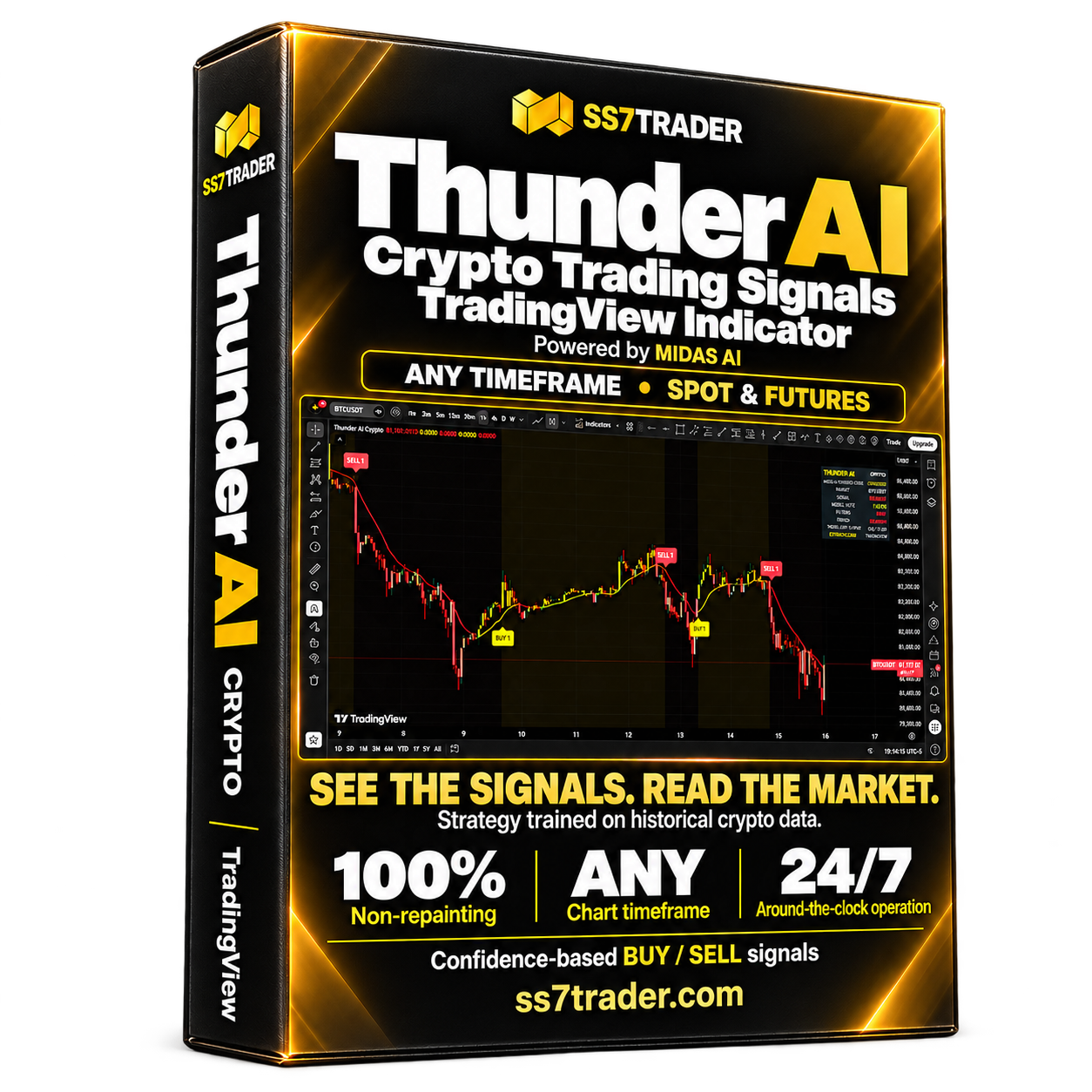
Thunder AI Crypto
A non-repainting TradingView signals indicator designed for crypto charts using a strategy trained on historical crypto data. Use it across timeframes for spot or futures analysis in the around-the-clock crypto market.
Explore Thunder AI Crypto ↗Match the exchange feed and instrument to your execution market, then apply your own position-sizing and risk plan. The indicator provides analysis; it does not make an exchange account, guarantee a fill or remove liquidation risk.
SS7TRADER’s MIDAS AI ecosystem uses research on 50M+ historical candles. Retraining happens centrally, and customers receive tested product updates. Non-repainting describes signal behaviour rather than a promised win rate. Read about our research approach and MIDAS AI ecosystem.
PREFER ANALYST-POSTED SETUPS?
Explore premium Crypto, Forex & Gold signals.
Visit the SS7 Signals Terminal to review the current service, available plans and access terms. Evaluate each setup against your market, execution conditions and risk limits.
View premium signals ↗Trading other markets too? Explore Thunder AI Forex & Gold for MT5 and Thunder AI Binary. Each product has its own supported platform and workflow.
Join the SS7TRADER community.
Follow public market posts and product updates. For help choosing or setting up our tools, contact Telegram support or WhatsApp.
Join t.me/ss7trader ↗Public channel access is free. Indicators and premium signals are separate paid offers.
RELATED VIDEO / ORDER CONTROLS
Explore advanced order types.
Tutorial by Josh Olszewicz, published in 2023 and disclosed by its creator as sponsored by Kraken. Included as interface-learning context; screens may have changed. It is not independent evidence for this comparison or an endorsement of SS7TRADER.
FREQUENTLY ASKED QUESTIONS
Crypto exchange questions, answered.
What is the best crypto exchange in 2026?
The best fit depends on the account available where you live, the markets you trade, total costs and your custody needs. This guide shortlists Binance, Coinbase, Kraken, OKX and Bybit by use case rather than declaring one universal winner.
Which crypto exchange should a beginner choose?
Start by checking eligibility, a clear deposit and withdrawal route, transparent order previews and manageable minimum orders. Learn unleveraged spot trading before considering margin or derivatives. An easy interface does not remove asset-price or custody risk.
Which crypto exchange has the lowest fees?
There is no single lowest-cost exchange for every transaction. Compare your pair, account tier, order type, spread, funding method and withdrawal route. Futures can add funding payments and other charges. Check the live account fee preview rather than relying on a permanent headline rate.
What is the difference between spot and crypto futures?
Unleveraged spot trading exchanges one asset for another. Futures and perpetuals give contractual exposure and can introduce leverage, margin requirements and liquidation. Perpetual contracts may also involve funding payments. A chart looking similar does not make the products equivalent.
Does a limit order always pay a maker fee?
No. A limit order that immediately crosses the book can execute as a taker. A resting order may be a maker when filled; partially matched orders can have both portions. Check the exchange rules and use post-only instructions only when you understand how rejected or cancelled orders are handled.
Can Thunder AI Crypto be used for spot and futures analysis?
Thunder AI Crypto is a TradingView analysis indicator designed for crypto charts, usable across timeframes and for spot or futures analysis. Match the exact exchange feed and instrument. It does not open an exchange account, place orders or remove funding, execution and liquidation risks.
Does non-repainting mean every crypto signal will win?
No. Non-repainting describes the indicator’s signal behaviour, not guaranteed trading results. Chart data, market conditions, execution costs and your risk plan still affect outcomes. Test the documented workflow before relying on a setup.
Does SS7TRADER receive compensation from the Binance link?
The Binance signup button uses our referral link, and SS7TRADER may receive compensation under the applicable partner terms. This guide does not promise a specific signup reward, fee discount, approval priority or withdrawal guarantee.
Is the SS7TRADER Telegram channel free?
Yes, the public channel at t.me/ss7trader is free to join. Thunder AI indicators and premium Forex, Gold and Crypto signals are separate paid offers. Use their current product and subscription pages to check access terms.
SOURCES & REVIEW METHOD
What we checked.
Reviewed by the SS7TRADER Research Team on 26 October 2026 using official exchange documentation. Provider features are attributed to the linked sources; use-case assessments, checklists and the hypothetical cost example are our analysis. We have not performed a comprehensive historical incident review, security audit or controlled account benchmark. The hero is an original AI-assisted editorial illustration.
- Binance spot trading guide and spot fee schedule
- Binance futures fee explanation
- Coinbase Advanced fees
- Kraken fee schedule
- OKX fees and products and futures demo guide
- Bybit trading fee structure
Crypto assets can be highly volatile. Derivatives add margin and liquidation risks. Products and account access vary by location; verify the current provider terms. No exchange, indicator or signal guarantees a profitable result.
RESEARCHING MARKETS SINCE 2015
Your market.
Your informed next step.
Connect with SS7TRADER for Crypto, Forex and Gold market posts, analysis tools and product support.