
This is a preview, with a recap of the morning figures already reported. The FOMC result and the markets’ actual post-decision performance are still pending at the timestamp above. Scenarios below describe what to watch, rather than claim a reaction has already happened.
What time is FOMC today?
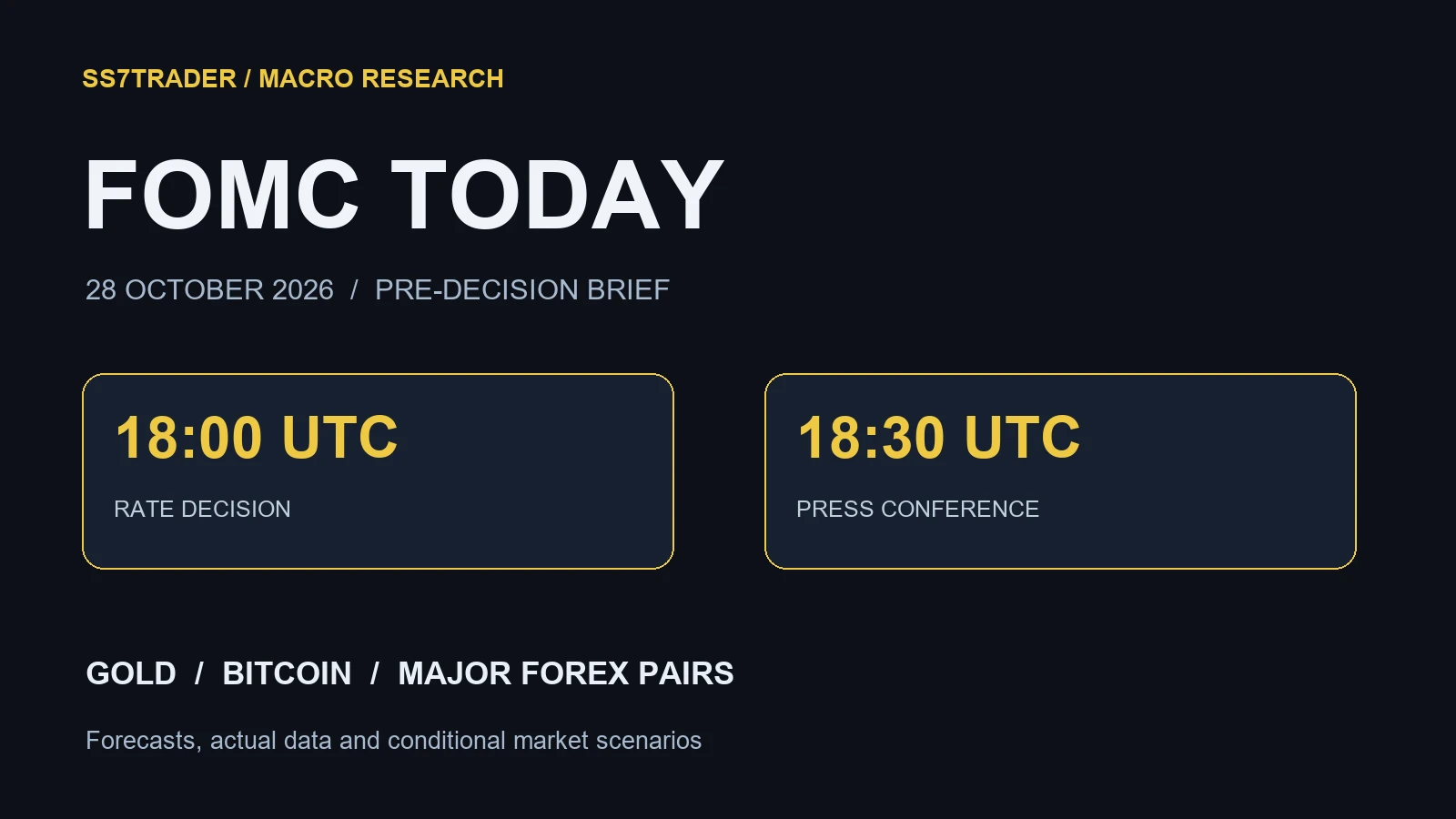
The policy announcement is scheduled for 14:00 New York / 18:00 UTC, followed by the press conference at 14:30 New York / 18:30 UTC on Wednesday, 28 October. New York is on EDT for this meeting. The Federal Reserve’s official October calendar confirms both events.
This October meeting does not have a scheduled Summary of Economic Projections. Traders should focus on the decision, wording, voting and press-conference guidance rather than expect a fresh dot plot. The Fed’s meeting calendar identifies which meetings include projections.
Today’s economic news: actual data versus expectations
| Event / UTC | Actual or status | Consensus / baseline | Prior reference |
|---|---|---|---|
| US goods trade, September · 12:30 | −$134.9bn reported | −$130.0bn, Trading Economics consensus | −$132.07bn revised |
| US wholesale inventories, September advance · 12:30 | +0.6% m/m reported | +0.5% | +0.5% |
| Bank of Canada decision · 13:45 | Pending at editorial check | 2.50% calendar consensus | 2.25% official current rate |
| EIA crude inventories · 14:30 | Pending at editorial check | 0.0 million barrels calendar consensus | −3.061 million barrels |
| FOMC decision · 18:00 | Pending | Hold at 3.75%–4.00% baseline | 3.75%–4.00% |
| Fed press conference · 18:30 | Pending | Guidance; no numeric consensus | Not applicable |
The larger-than-expected goods deficit can weigh on estimates of net exports, but imports can also reflect domestic demand. Inventories contribute to GDP calculations, yet a build can mean either planned restocking or unsold goods. Neither number, by itself, supplies a reliable Gold or Bitcoin direction.
What is the Fed predicted to announce?
The latest completed Fed decision raised the target to 3.75%–4.00%, according to the 16 September statement. An unchanged range is the October baseline reflected in current previews and rate calendars. A calendar showing “4.00%” generally reports the upper bound, not a separate 4%–4.25% range.
The important comparison is the decision against what traders already expected. Holding rates can still produce a hawkish reaction if guidance raises expectations for further tightening. The same hold can look dovish if the Fed sounds more comfortable with inflation and less inclined to tighten again. This briefing does not assign an unverified live probability; check CME FedWatch for changing futures-implied pricing.
How markets often behave before FOMC
Before the announcement, traders may cut exposure, hedge positions or wait for the event. That can produce a tight range, uneven liquidity and breakouts that fail quickly. Pre-event direction is positioning, not proof that somebody knows the result.
Mark the session high and low, the last clear support and resistance, and the dollar’s direction. Compare Gold with Treasury yields and Bitcoin with the broader risk environment. A quiet morning does not mean the statement window will be quiet.
Gold (XAUUSD): what matters after the decision?
Hawkish surprise: if traders price a tighter future path and US real yields rise, the opportunity cost of holding non-yielding Gold increases. A firmer dollar can add pressure. The bearish interpretation becomes more convincing when both yields and the dollar confirm the move and Gold remains below the broken session level.
Dovish surprise: lower rate expectations, falling real yields and a softer dollar can support Gold. Look for a sustained break or a successful retest rather than infer a trend from the first spike. Geopolitical demand and other flows can override the usual relationship; a hawkish headline does not guarantee falling Gold.
Bitcoin (BTCUSD): liquidity expectations versus leverage
Bitcoin often responds to changes in expected financial conditions. A softer policy path can support risk appetite, while a higher-for-longer message can pressure speculative exposure. These are conditional channels, not a fixed correlation with every Fed decision.
Crypto futures add another layer: leveraged liquidations can exaggerate the first move in either direction. Compare spot participation with the futures move, and watch whether BTC holds outside its pre-event range. A liquidation squeeze that immediately reverses is different from sustained spot buying.
Major-chart reaction map
| Market | Hawkish surprise: conditional bias | Dovish surprise: conditional bias | Confirmation to watch |
|---|---|---|---|
| Gold / XAUUSD | Pressure if real yields and USD rise | Support if real yields and USD fall | Yield direction + session-level acceptance |
| Bitcoin / BTCUSD | Risk appetite may weaken | Risk appetite may improve | Spot demand + range hold; liquidation risk |
| EURUSD / GBPUSD | Potential pressure from stronger USD | Potential support from weaker USD | Dollar breadth + local European/UK news |
| USDJPY | Potential support from higher US yields | Potential pressure from lower US yields | US–Japan rate spread + yen risk sentiment |
| USDCAD | USD support possible | USD pressure possible | Today’s BoC decision and oil can dominate |
| Silver / Oil | USD headwind possible | USD relief possible | Industrial demand, oil supply and EIA data |
After FOMC: three scenarios to prepare for
- Hold, hawkish guidance: watch for higher yields and dollar strength. Gold and BTC downside needs confirmation after the initial release candle; a failure to extend weakens the headline-driven interpretation.
- Hold, softer guidance: watch whether yields and the dollar fall together. Gold and BTC strength is more credible if the breakout survives the press conference and participation broadens.
- Mixed signals or unexpected policy action: the first move can reverse as traders read the statement and hear answers. A return inside the pre-event range may indicate two-way trading rather than an established trend.
The statement and press conference are two separate information waves. The first move at 18:00 UTC can change around 18:30 UTC. A candle close, retest and continued acceptance outside the event range can help distinguish a move that is holding from a temporary price excursion, without guaranteeing continuation.
A practical FOMC execution checklist
- Check the actual decision and statement before relying on social-media headlines.
- Reassess spreads and slippage; the risk budget can change materially around release time.
- Define invalidation from chart structure and calculate position size from that distance.
- Avoid treating a forecast as a result or a model signal as a guaranteed fill.
- Review the next session: a move that survives the press conference can still face a fresh catalyst.
What comes next?
Thursday’s calendar includes US GDP and PCE inflation, which can change the interpretation of today’s guidance. Verify the current release schedule and forecasts before the next session. This article will remain a dated preview unless it is explicitly updated with the decision and timestamped market observations.
Frequently asked questions
Will Gold go up after FOMC?
There is no fixed outcome. Gold’s response depends on the policy surprise, real yields, the dollar and competing demand. An unchanged rate alone does not determine direction.
Is FOMC bullish or bearish for Bitcoin?
A softer expected policy path may support risk appetite, while a tighter path may pressure it. Crypto positioning and liquidations can produce sharp reversals around either outcome.
Does an unchanged rate mean markets will not move?
No. Guidance can change the expected future path even when the current range stays unchanged.
Has today’s FOMC result been released?
Not at the editorial timestamp shown above. The scheduled decision is 18:00 UTC on 28 October 2026.