
What is liquidity in Forex and crypto trading?
Understand the orders behind the price: spreads, market depth, slippage and the difference between a liquidity sweep and a confirmed breakout.
Market liquidity is the ability to buy or sell a desired quantity near the quoted price without causing a large price change. A liquid market usually has competitive bids and offers, enough available size and participants willing to replenish orders. Liquidity affects execution costs; it does not predict whether your trade will win.
Liquidity is more than trading volume
Imagine buying a small amount of a widely traded currency pair. If several participants quote competitive prices with enough size, the transaction may execute close to the displayed quote. Increase your order dramatically, or trade when quotes are thin, and execution can become more expensive.
Volume measures how much has traded over a period. Liquidity describes what can be traded now, at what prices and in what quantity. High historical volume does not guarantee a deep market during your next order. Displayed orders may also be cancelled before you reach them.
Spread
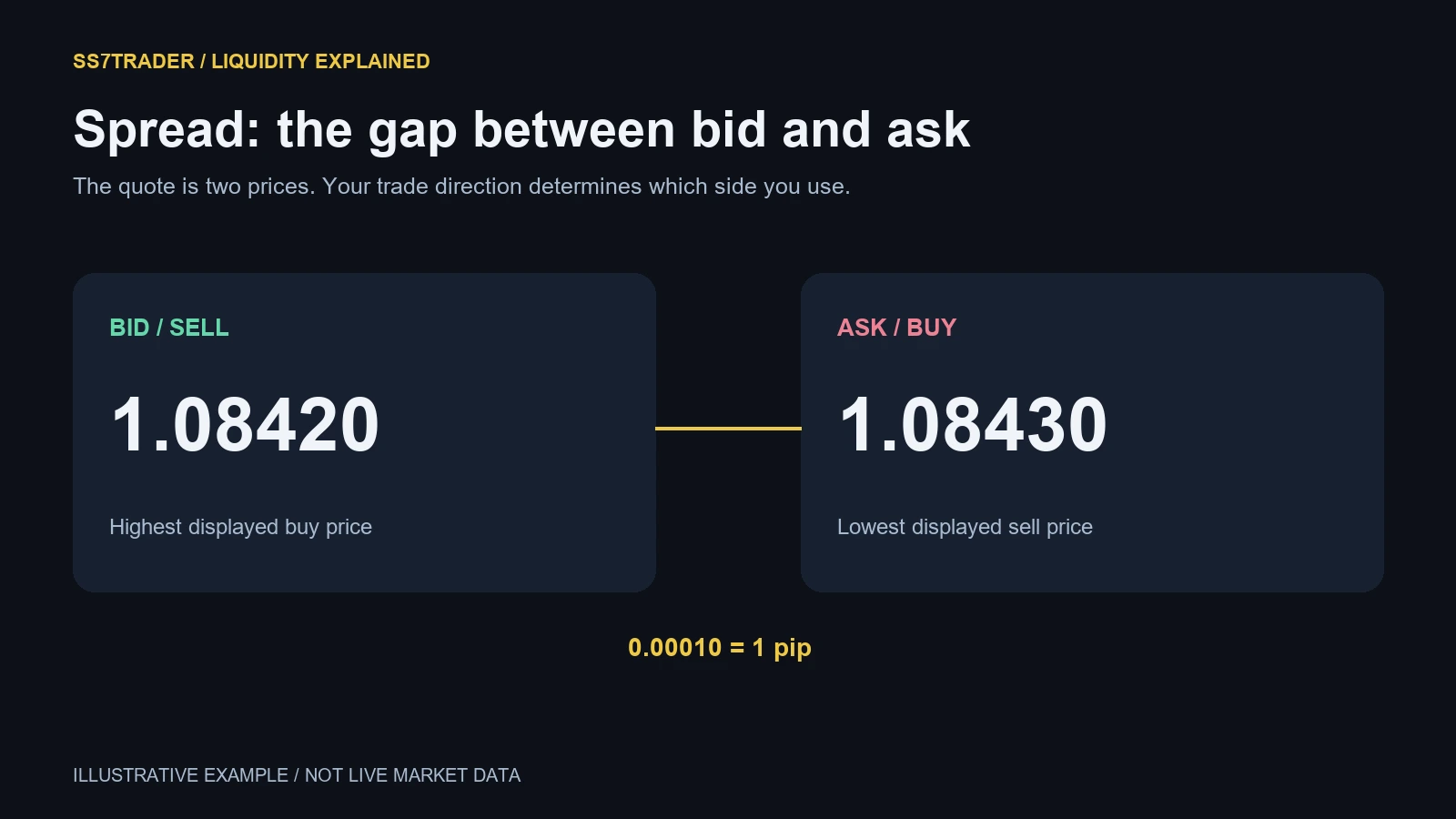
The difference between the best available bid and ask. A narrow spread is useful, but says little about the size available behind it.
Depth
The quantity available at successive prices. Your order size matters relative to that available quantity.
Resilience
How readily the market replenishes quotes after trading or disruption. Depth can disappear during fast-moving news.
Who provides and consumes liquidity?
In an order-book market, resting buy and sell limit orders provide available interest. A market order normally consumes the available opposite-side orders. Banks, dealers, market makers, funds and other traders can participate, depending on the market. A limit order that immediately crosses the spread can also take liquidity; “limit” does not automatically mean “maker.”
An exchange order book lists bids, asks and their quantities. It is a snapshot, not a promise that every displayed order will remain available.
Forex liquidity vs crypto liquidity
| Question | Forex | Crypto |
|---|---|---|
| Where does trading happen? | A fragmented OTC network of dealers and trading venues. | Multiple centralised exchanges and decentralised protocols. |
| Is there one complete order book? | No single global spot-FX order book. | Each exchange, pair and product has its own liquidity. |
| What changes execution? | Pair, session, news, broker routing, available quotes and size. | Venue, pair, token, order size, news, funding conditions and time. |
| When can conditions weaken? | Rollover, holidays, quiet periods and sudden releases. | Quiet periods, weekends, venue disruptions and sharp sell-offs. |
The BIS describes a fragmented FX execution landscape, including dealer platforms and internal liquidity pools. A retail platform’s depth display therefore should not be read as every currency order worldwide.
On crypto exchanges, BTC/USDT spot, BTC/USD spot and a BTC perpetual contract are separate markets. A deep Bitcoin market on one exchange does not establish the same execution quality for a small token or another venue. Similarly, a broker’s Gold CFD quote is not the complete physical-gold or futures market.
What about decentralised liquidity pools?
Some decentralised exchanges use automated market makers rather than a conventional matching order book. Users trade against pool reserves under the protocol’s pricing rules. Trade size relative to available liquidity affects price impact. A slippage tolerance sets a transaction constraint; it does not guarantee the quote, successful execution or protection against every execution risk.
Why your fill can differ from the price you saw
A market order prioritises execution against available prices. If the first price level cannot satisfy the whole order, subsequent parts can fill at worse levels. Price impact is the effect of your own trade on available prices; slippage is the difference between an expected price and the actual execution price. Market movement and latency can also contribute.
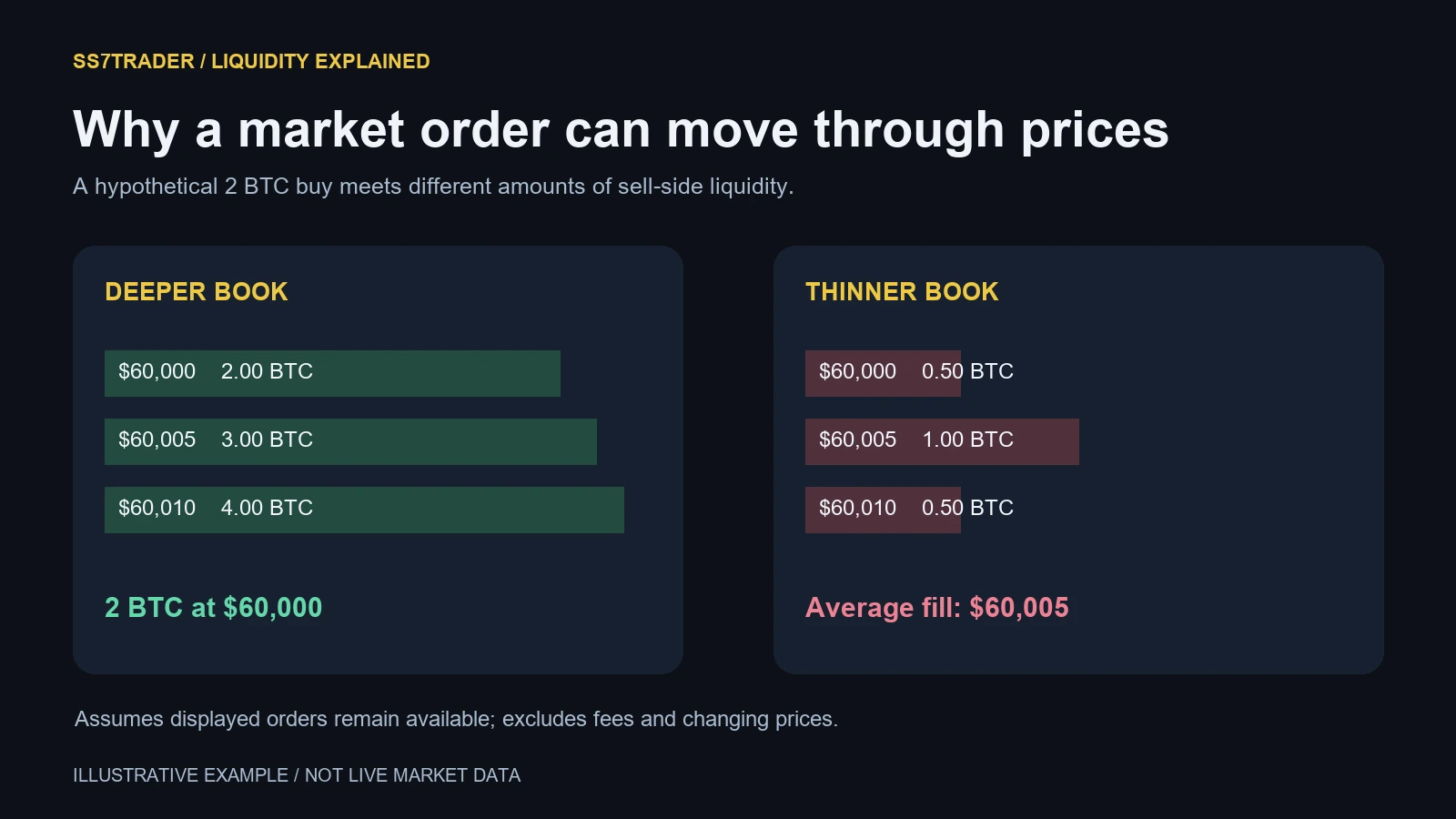
Suppose you buy 2 BTC. In a deeper book, 2 BTC is available at $60,000. In a thinner book, only 0.5 BTC is offered there, with 1 BTC at $60,005 and another 0.5 BTC at $60,010. If those offers remain available, the second order fills at an average of $60,005, before fees.
Market orders, limit orders and stops
A limit order controls the worst price you accept, but it can remain unfilled or fill only partially. A market order can execute quickly while accepting available prices. Stop orders depend on the venue’s trigger rules: after activation, a stop-market order can slip, while a stop-limit order may fail to fill.
Compare spread, commission, funding where applicable and likely execution together. A low displayed fee alone does not make a venue the cheapest for your trade. Read the platform’s order rules; see Binance.US on price impact and slippage and Coinbase order management.
What is a liquidity sweep?
Chart traders often use “buy-side liquidity” for potential buy orders above prior highs, and “sell-side liquidity” for potential sell orders below prior lows. For example, a trader short from a lower price may place a protective buy stop above a high. Breakout traders may also buy above that level.
This charting language differs from order-book liquidity. Stop orders are generally conditional rather than resting executable limit orders. When triggered, they can become aggressive orders under the venue’s rules. A prior high suggests a level worth observing; it does not reveal the number, size or exact location of hidden stops.
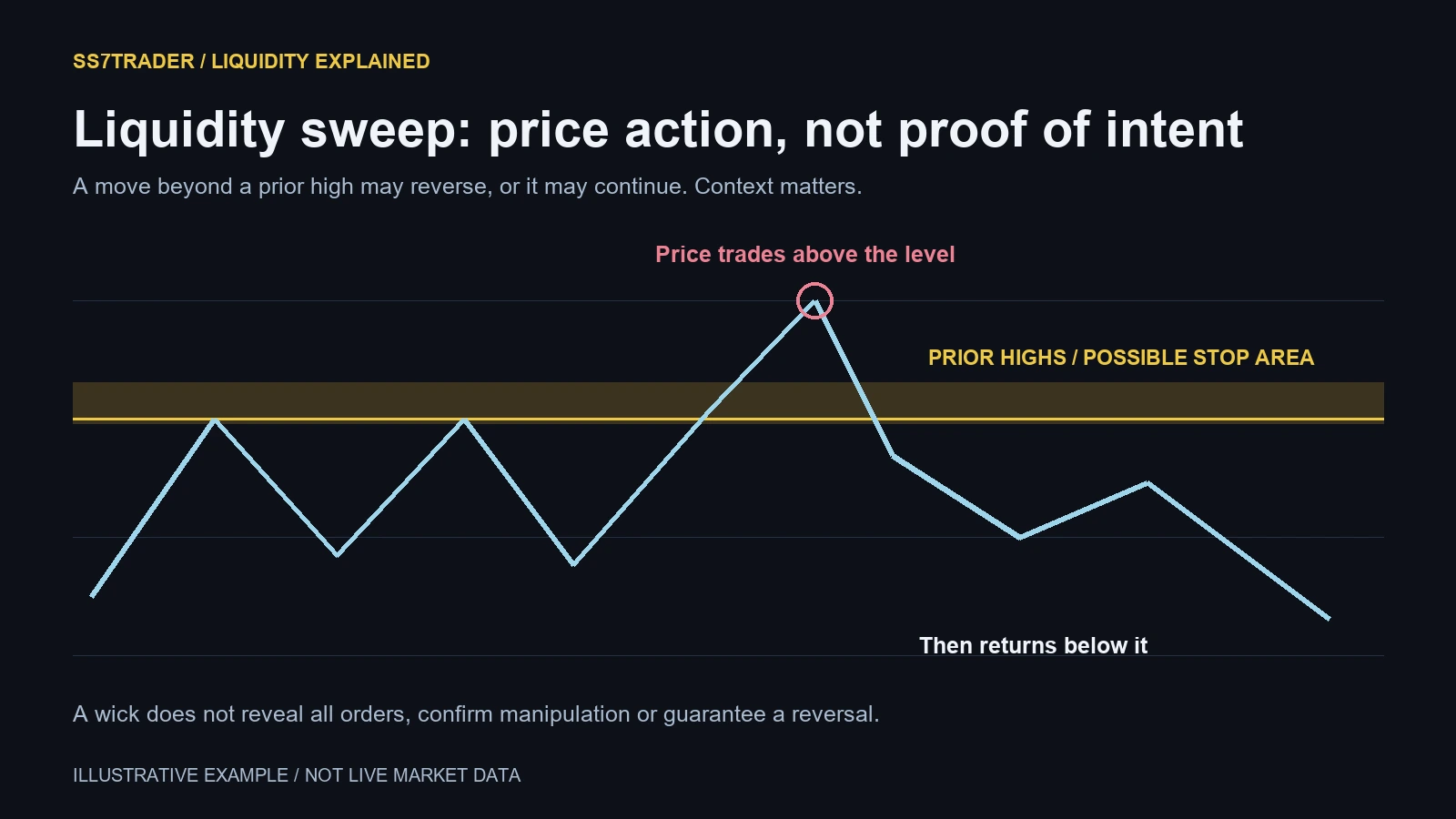
A liquidity sweep commonly describes a move beyond a visible high or low followed by a return inside the prior range. A breakout describes a move beyond a boundary; whether it holds or fails must be assessed as more price action develops.
How to evaluate a possible sweep
Mark the level before the move. Observe whether price closes back inside or continues to hold beyond it, then compare the result with higher-timeframe structure, volatility and scheduled events. Define what would invalidate your interpretation before placing an order. A similar-looking pattern can fail in a different market regime.
Crypto liquidations are another concept: leveraged positions may be forcibly closed when margin requirements are breached. Those orders can interact with a thin book, but a liquidation is not the same thing as liquidity. Avoid treating an unverified liquidation map as a complete inventory of future orders.
A practical liquidity checklist
- Check the exact instrument. Confirm the exchange or broker, pair, spot or derivatives product and contract size.
- Inspect current costs. Check spread, fees and available depth relative to your intended size.
- Check the clock and news. Use our Forex market sessions clock and economic calendar. London–New York participation can be relevant to major FX pairs, but busy sessions still carry event risk.
- Choose the order deliberately. Understand the trade-off between price control and execution certainty. Verify stop triggers and partial-fill behaviour.
- Plan the downside. Size from your risk budget and allow for possible execution gaps. A stop-loss level is not always the final fill price.
- Record actual fills. Compare expected and executed prices in your journal. Test assumptions across different sessions and conditions.
Crypto generally trades around the clock, while Forex and broker-provided commodities follow their own schedules. Check the actual symbol’s holiday and maintenance hours. A session label is context, not a stand-alone entry signal.
Liquidity FAQs
Is high liquidity bullish or bearish?
Neither by itself. Liquidity concerns execution and available trading interest. A highly liquid market can rise, fall or move sideways.
Is liquidity the same as volume?
No. Volume describes completed trading over a period. Liquidity describes the ability to execute a particular size near available prices now.
Can I see all Forex liquidity on MT5?
No. Spot Forex is fragmented. A broker’s depth display reflects the quotes or liquidity it exposes, not a complete global order book.
Does a liquidity sweep always reverse?
No. Price can return inside a range and later break out again. A wick or sweep is an observation that needs context, confirmation rules and a defined invalidation.
Why can Bitcoin slip even on a large exchange?
Execution depends on the exact pair, product, available depth and order size at that moment. Large orders or sudden volatility can consume nearby prices even on a popular venue.
Does a limit order eliminate all execution risk?
No. It limits the acceptable execution price but may remain unfilled or only partly filled. Fees and venue-specific rules still apply.