
Bitunix Futures Guide: Margin, Funding, TP/SL & Liquidation
Understand Bitunix perpetual futures, isolated and cross margin, mark price, funding and TP/SL. Follow an educational risk checklist before using leverage.
Partner promotion: SS7TRADER may earn commission from eligible referral activity. No fixed customer bonus or discount is promised. Check regional eligibility and current terms. Crypto and leveraged products carry loss risk.
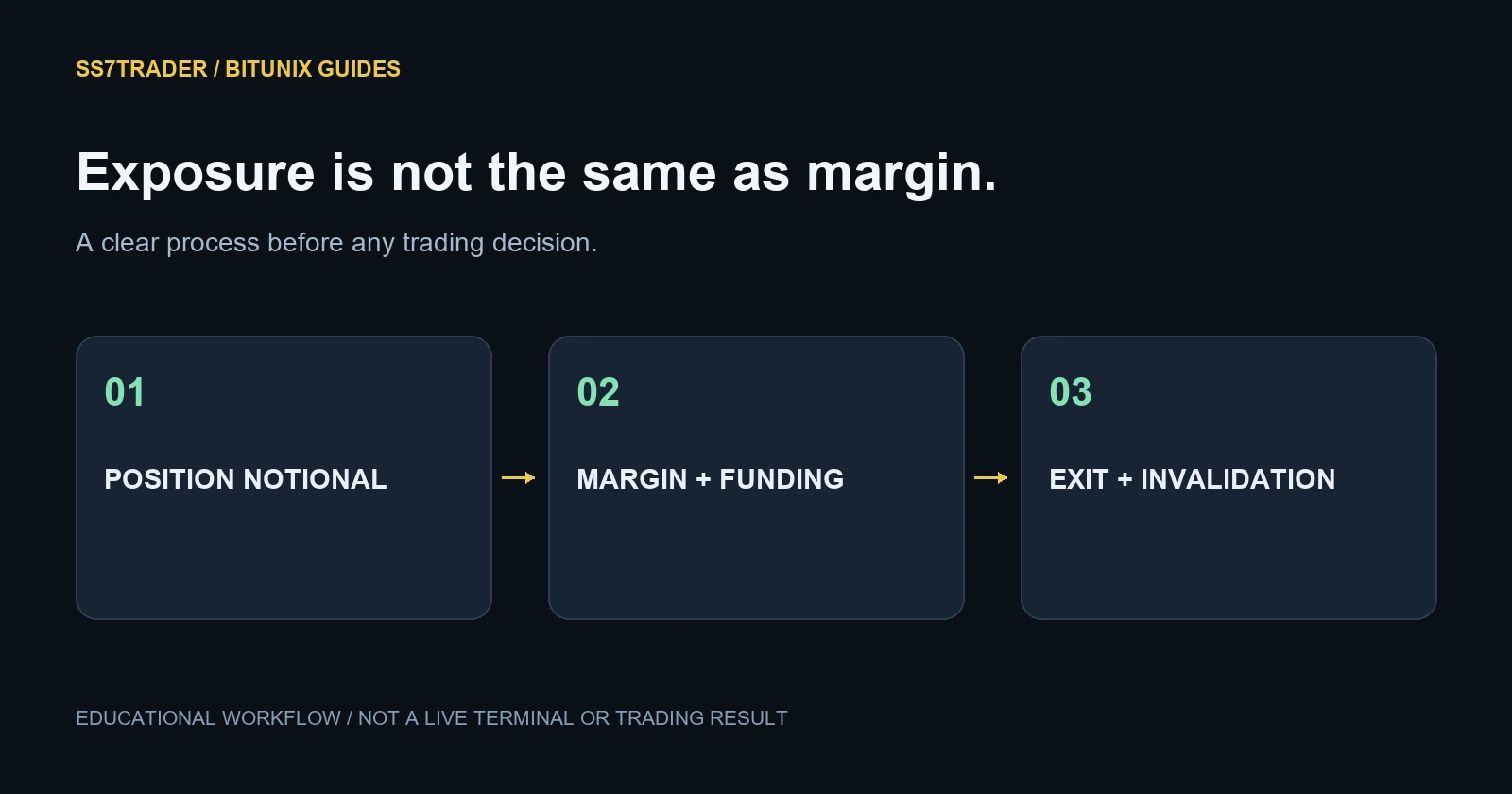
Bitunix perpetual futures give contract exposure rather than a spot asset purchase. Before considering an order, understand position notional, collateral, margin mode, funding and the price used for liquidation. Higher leverage reduces the room for adverse movement; it is not a trading edge.
Start with the contract, not the leverage slider
Read the selected symbol, settlement asset and product details. A contract can track the same underlying asset as a spot pair while having its own price and costs. Long and short describe exposure direction, not certainty about the next candle.
Write down a condition that would disprove the setup. Calculate the amount you could lose at that exit, including an allowance for costs and possible slippage. Choosing size first and then moving the stop to justify it reverses that process.
Notional and initial margin: a simple example
In a simplified example, 500 USDT of initial margin at 5× supports 2,500 USDT of notional exposure. A 1% adverse move represents approximately 25 USDT of price loss, or 5% of that initial margin, before fees and funding. This is arithmetic, not a liquidation formula.
Actual required margin and liquidation depend on contract rules, maintenance requirements, account settings and position changes. Never infer an exact liquidation price from leverage alone.
Cross margin and isolated margin
Bitunix’s futures terminology guide distinguishes isolated position margin from a shared cross-margin pool. Read the mode on the order panel and on the position itself. Shared collateral can expose more of the applicable account balance; isolated margin requires attention to allocated collateral.
Do not assume an isolated setting makes a trade harmless or that adding margin repairs a failed setup. Before entering, understand any automatic margin-replenishment setting and what funds it can use.
Mark price is different from last price
The last price is the latest executed trade. The platform’s mark price is a separate risk reference. Inspect the contract’s liquidation rules rather than assuming the visible candle must touch a particular price before liquidation. The official liquidation guide explains the role of margin requirements and risk calculations.
A displayed liquidation estimate is not an exit strategy. Liquidation can remove your control over closing a position. Plan an invalidation well before relying on the platform’s forced-close process.
Funding and holding a perpetual position
Funding can add a payment or receipt at the contract’s settlement times. Check the current countdown, sign and position notional. Intervals can differ by contract, so one generic “every eight hours” assumption is insufficient.
A trade can be directionally correct and still produce a disappointing result after costs. Keep a record of opening and closing charges and each funding settlement. See the Bitunix fee examples for the distinction between margin and fee notional.
TP/SL and the pre-order checklist
Take-profit and stop-loss instructions define conditions for an exit, but trigger basis and execution method matter. A stop-market order can slip; a stop-limit instruction may fail to fill. Check whether an exit reduces or closes the intended position and whether any old orders remain.
Before any live order, confirm contract, direction, quantity units, margin mode, collateral, leverage, estimated costs, trigger reference and invalidation. Use a demo environment where available to learn the controls without turning the learning exercise into a leveraged bet.
Our signals platform and research pages explain SS7TRADER’s analysis workflow. No signal replaces exchange rules or guarantees protection from liquidation.
Frequently asked questions
Do perpetual futures expire like dated futures?
They normally have no fixed expiry, but positions remain subject to margin, funding, liquidity and platform rules.
Does more leverage improve the strategy?
No. It changes exposure relative to collateral and increases sensitivity to adverse movement.
Is the chart’s last price the liquidation reference?
Not necessarily. Check the contract’s mark-price and liquidation rules on Bitunix.
Does a stop-loss guarantee the exit price?
No. Execution depends on the order type and available market conditions.
Continue through the Bitunix guides
Sources and review method
Platform-specific facts were checked against the official pages linked here. Examples are hypothetical. This is SS7TRADER’s explanatory guide, not an independent audit or a claim that we tested every feature. Fees and policies can change after review.
Bitunix official documentation: Futures ↗Bitunix official documentation: Liquidation ↗Bitunix official documentation: Funding ↗