
Bitunix Fees Explained: Spot, Futures & Trading Cost Examples
Understand Bitunix maker and taker fees, spot and futures costs, funding and withdrawal charges. Compare clear examples with the official live fee schedule.
Partner promotion: SS7TRADER may earn commission from eligible referral activity. No fixed customer bonus or discount is promised. Check regional eligibility and current terms. Crypto and leveraged products carry loss risk.
The official VIP 0 table checked on 29 October 2026 lists spot fees of 0.08% maker / 0.10% taker and futures fees of 0.02% maker / 0.06% taker. These are trading fees, not the full cost of a position. Your account, VIP tier, pair and promotions can change the applicable rate.
Bitunix spot and futures fee table
The official Bitunix fee schedule is the source of truth. The following VIP 0 snapshot is for orientation, not a permanently locked price.
| Market | Maker | Taker |
|---|---|---|
| Spot / VIP 0 | 0.08% | 0.10% |
| Futures / VIP 0 | 0.02% | 0.06% |
Higher tiers have different rates. Inspect your own fee tier before submitting an order rather than assuming a screenshot or search result reflects the current account rate.
Maker and taker: how execution changes the fee
A maker order adds resting liquidity to the book. A taker order executes against available liquidity. Market orders normally take liquidity; a limit order can also take liquidity if it crosses the spread immediately.
For example, a buy limit above the current best ask may execute at once. Calling it a “limit” does not ensure the maker rate. Where supported, post-only instructions can reject an order that would take liquidity, but they also change execution behaviour.
Worked example: a spot round trip
Assume a hypothetical 1,000 USDT spot buy and a later 1,000 USDT sale, both charged at 0.10%. The fee estimate is 1 USDT per side, or 2 USDT total. This deliberately assumes unchanged trade value and excludes price movement, spread, slippage and asset-specific fee treatment.
At 0.08%, the same simplified arithmetic gives 0.80 USDT per side. Actual execution can be mixed across maker and taker fills, and the exit value need not equal the entry value. Use the final fill records for accounting.
Worked example: futures fees use position notional
A hypothetical 10,000 USDT futures position charged at a 0.06% taker rate costs 6 USDT to open. Closing another 10,000 USDT notional at the same rate adds 6 USDT. The simplified round trip is 12 USDT before funding and execution effects.
Calculate the fee from notional, not just the margin posted. If a position has 1,000 USDT of initial margin supporting 10,000 USDT of exposure, the fee basis is still the executed exposure. Leverage magnifies exposure; it does not make that exposure free to trade.
Funding is a separate line item
Perpetual funding is a periodic payment associated with holding an eligible contract at settlement. Bitunix’s funding explanation distinguishes it from ordinary transaction charges. Confirm the contract’s current rate, direction and settlement interval.
For a purely hypothetical 10,000 USDT position and a 0.01% rate, the settlement amount is 1 USDT. Whether the trader pays or receives depends on the rate sign, position direction and applicable rules. Do not project one current rate indefinitely into the future.
Withdrawal and execution costs
Check the coin and network on the withdrawal preview for the current charge, minimum and net received amount. Do not choose a network only because it is cheaper: the receiving service must support it.
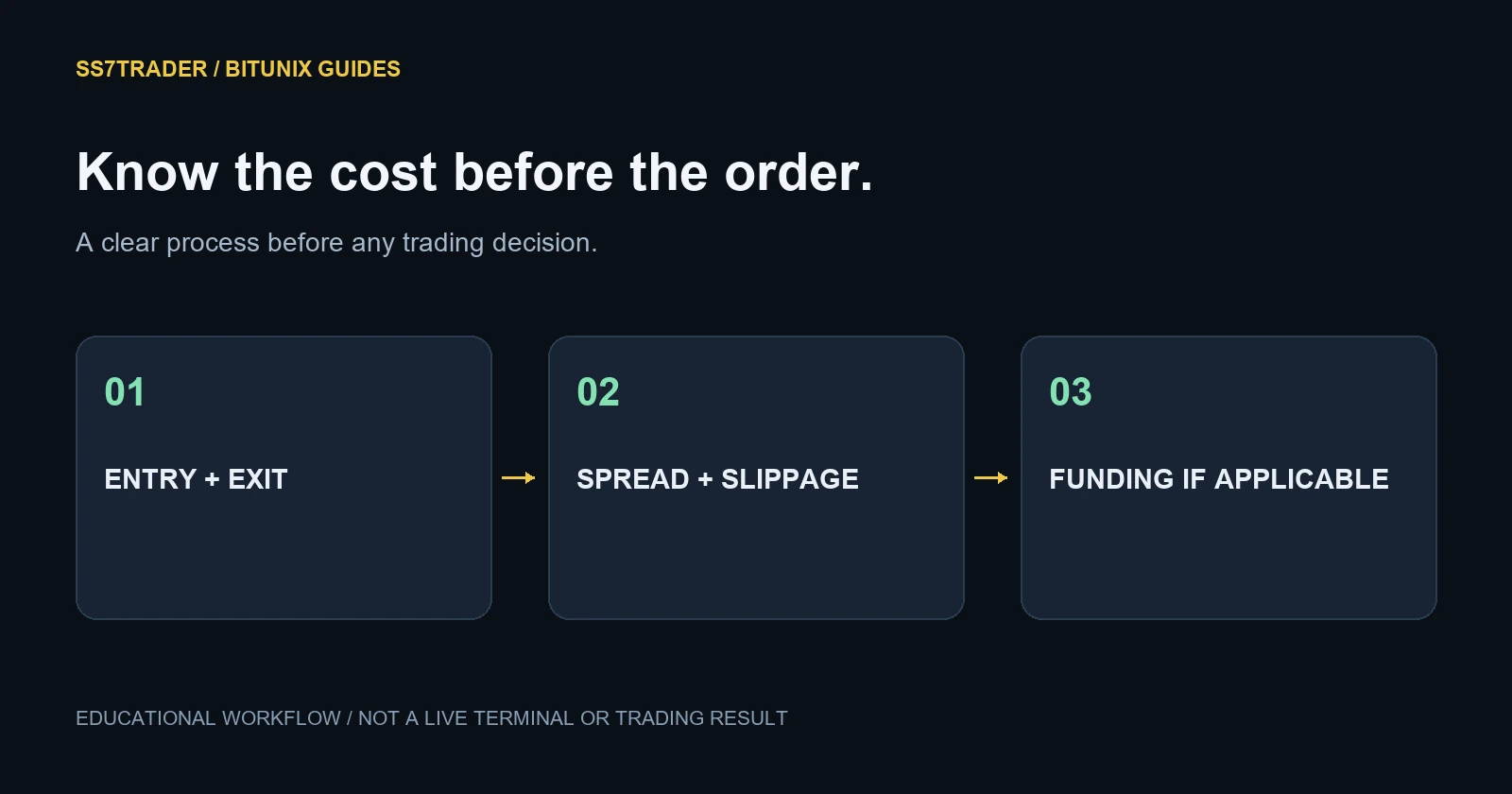
A low fee is only one comparison factor. Record the spread at entry, actual fill, final transaction fee and funding. Our liquidity guide explains why a thin book can cost more than a small difference in the headline trading rate.
Frequently asked questions
Does a limit order always pay the maker rate?
No. A limit order that immediately matches existing orders can take liquidity and pay the taker rate.
Are futures fees based on my margin?
The worked examples use executed position notional. Check the contract’s fee rules and your actual fill record.
Does the referral code guarantee lower fees?
No customer discount is promised here. Confirm any rebate or promotion in its current official terms.
Can the published rates change?
Yes. Check the official fee page and your account tier before trading.
Continue through the Bitunix guides
Sources and review method
Platform-specific facts were checked against the official pages linked here. Examples are hypothetical. This is SS7TRADER’s explanatory guide, not an independent audit or a claim that we tested every feature. Fees and policies can change after review.
Bitunix official documentation: Fees ↗Bitunix official documentation: Funding ↗